

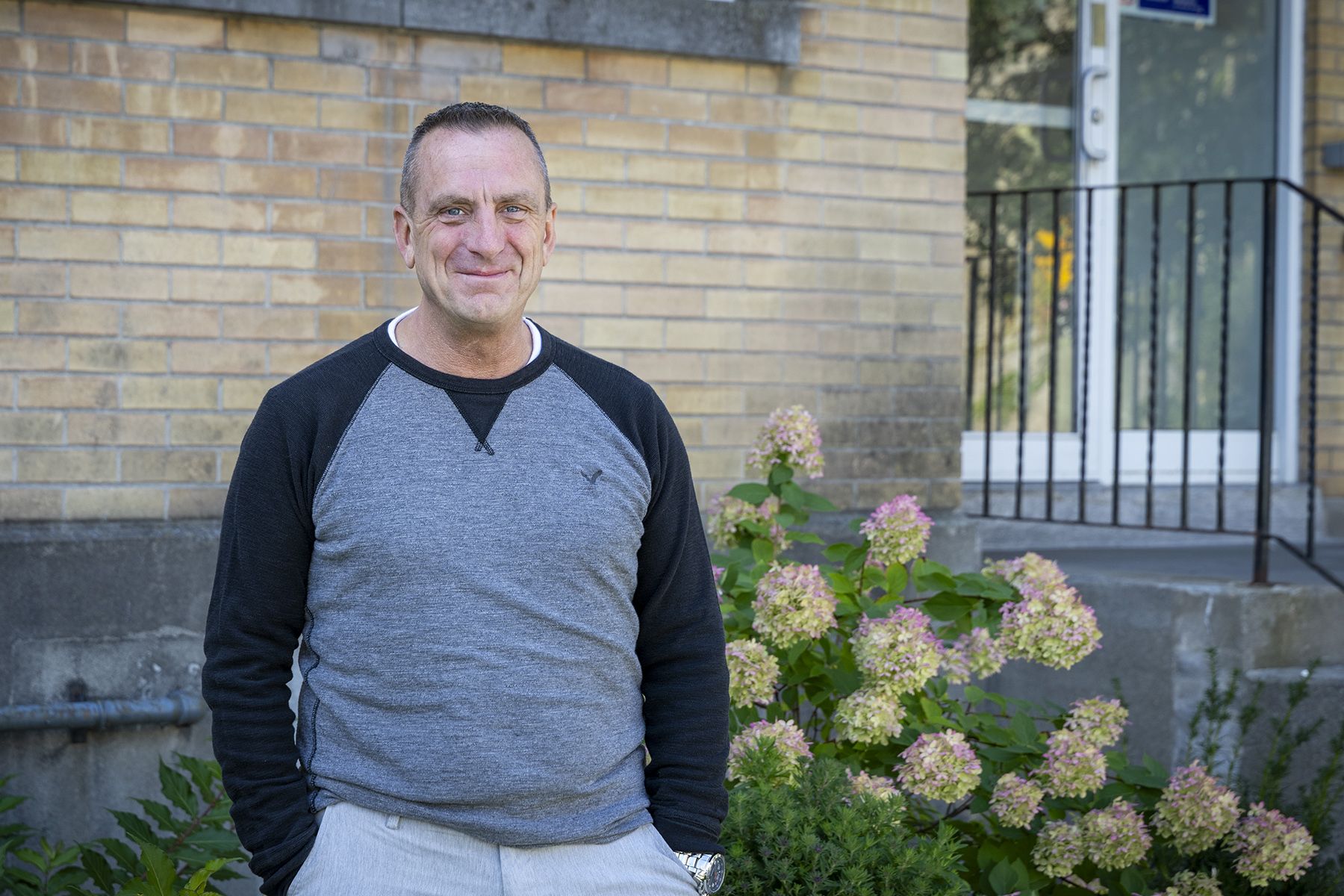
Ron Summers stands in front of KHSC's Withdrawal Care Centre, where his addiction recovery started more than a year ago.
Credit
Matthew Manor
In just over one year, Ron Summers has gone from using stimulants daily and living in a friend’s garage to being in recovery, actively volunteering in the community and renting a townhome.
While that’s a lot of progress in 13 months, Summers says, “I didn’t rush into this [recovery]. I had decades of research in the field.”
For 45 years, he used substances to manage his feelings. It wasn’t until six years after his fiancée’s death that he arrived at Kingston Health Sciences Centre’s (KHSC) Withdrawal Care Centre (formerly known as the Detoxification Centre), no longer able to numb his emotions.
“When she died in a car crash, that’s when things got dark. I just wanted to crawl into a hole. And I did.
“By the time I got to ‘detox,’ I was emotionally, physically and spiritually bankrupt. I thought I was going to die using.
“But then this woman with this big smile talked to me and seemed to look right at me. She looked happy and made me feel like there was no shame in what I was going through.”
Sometimes, all it takes is one person to see you as someone who deserves to heal. For Summers, that person was Alicia Howell, a KHSC addiction care worker.
“It was so genuine, her wanting to help me. She offered support to get me into residential treatment. Unbelievably, because I used to think asking for help was a sign of weakness, I said, ‘yes, please can you help me get there?’ I wanted immediately what she had: happiness and kindness.”
Tracing the pattern
Summers says he was “done” when he met Howell, and he thought she could sense it.
She threw me a lifebuoy. I grabbed a hold of it and for once in my life I took suggestions, even if I didn’t want to hear them. I could have what she and others had, but first I needed to do a couple of things that were uncomfortable.
With the assistance he received at KHSC’s Withdrawal Care Centre, he made it to Kingston Harbour Light, a residential addiction treatment centre for men, where he discovered cognitive behavioural therapy (CBT).
“After digging around and trying to understand why I kept doing the same things over and over again, some answers started to come.”
Through CBT, feeling “less than” was traced back to a traumatic childhood experience.
“I would not like that feeling and any kind of similar feelings would be dealt with through substance use. Repeat, repeat, repeat. I didn’t know how to navigate those feelings any other way.”
It was the early 1980s, when Summers was eight or nine, he was at home while his mom was at work, and her boyfriend and his friends were there drinking. When Summers bragged that he could get out of any knot, they tied him up, duct-taped his mouth, hung him on the wall and left him alone.
“That’s when I realized I didn’t matter,” says Summers. “That I didn’t have a voice.”
Around the same time, a stepsibling introduced him to gas sniffing. Experimentation continued through his formative years, as did the neglect he experienced from extended family. Though he did well in high school and played competitive hockey and soccer, he never felt like he fit in. His substance use expanded to marijuana, alcohol and cocaine, and by his twenties he was regularly using stimulants for a false sense of confidence, stability and happiness.
The happy mask
“People saw me as someone who had a successful career, was a family man, funny, helping others, but I was dying inside.”
At one point, Summers served as public relations liaison for police and fire associations across Canada, providing handbooks on child safety and on alcohol and drug awareness. He also promoted Canadian heavyweight boxing champion George Chuvalo, who spoke to youth about losing three of his sons and late wife to addiction and suicide.
“That still wasn’t enough for me to see that I needed help.
“When I look back now, there were so many people who wanted to help me, but I could not receive it. I could not fathom admitting I had a problem. Even though I went to prison or jail, it was always something else… this time it’s going to be different.
“My addiction tricked me into thinking I had my stuff under control. I had lines I wouldn’t cross until I would, and a new line would be made.
“When I stopped making excuses, that’s when the healing started.”
Trusting the process
Recovery is much more than stopping the use of substances. It’s learning new ways to cope with and manage difficult emotions and reconnecting with oneself and others.
Mantras like “do the next right thing,” a favourite of Summers’, can help.
His first right thing was trusting Howell when she said she thought he looked like he wanted to make changes.
“She advocated for me like I mattered. She was real at a point in my life when I needed something real. She made me feel ‘not less than.’”
After residential treatment, other right moves included starting a Narcotics Anonymous (NA) meeting and a Harbour Light Alumni meeting at St. Vincent de Paul and volunteering there four hours every day.
“Through volunteering, people don’t see my challenges. They see my value in helping others. Somebody did that for me. Didn’t judge me at my worst and that let my good traits come out.
“I’m the happiest I’ve ever been, now that I’ve opened my mind to a better way.
“When I stuff things down, and I don’t talk about them, as small as they may seem, they keep building up and I bleed on people that didn’t cut me.
“When I get these emotions and feelings and want to use, it’s not a bad thing, it’s an early warning sign. I call my NA sponsor and talk and it works. It’s instructions, like Ikea.
“I got out of my own way and tried and now I have so many opportunities to give back.”
In addition to his work at St. Vincent de Paul, he offers peer support at Harbour Light, volunteers on KHSC’s Mental Health and Addiction Care unit and participates on Limestone City Co-operative Housing’s advisory committee.
“What I’m doing right now is a lot, but it’s going to save my life. It’s making me feel like I have a voice, like I matter to other people.
“Everything falls into place. I just do the next right thing.”


